Mohorovicic Discontinuity at Coverack
I’ve always loved the words plate tectonics, although until now it’s been impossible to toss them casually into conversation as often as I’d like. But not so any more, because understanding the geological importance of the Lizard peninsula isn’t possible without discussing plate tectonics. As we'll be hiking the South West Coast Path around the Lizard peninsula on our September 2016 trip, here’s my chance to use plate tectonics as often as I like.
Once upon a time about 390 million years ago, continental drift (another fine set of words) caused two tectonic plates to collide: Specifically, the Normannian tectonic plate subducted (had to look that up*) under the Laurasian plate. Probably it made a loud noise but we’ll never know. A bunch of things must have happened in that crash but there are two that are especially fascinating.
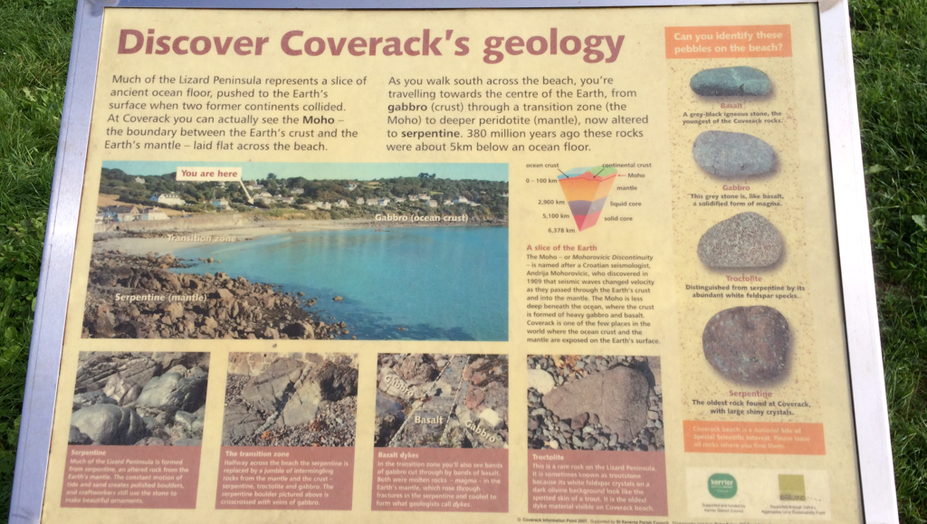
The first involves Mohorovicic Discontinuity (or moho), which usually lies miles under the ocean and is pretty hard to get to. The Lizard is one of the few places on earth where moho is seen at the earth’s surface. So of course we want to see it. I plan to stand on a bit of real live Mohorovicic Discontinuity and feel special and privileged and take a few photos to impress family and friends.
I looked up Mohorovicic Discontinuity: The earth, as we learned long ago but may have forgotten, has a core, a mantle, and an outer crust. The crust is made of different plates, the movement of which is called plate tectonics. When the Lizard tectonic plates collided, rocks that were normally found only in the earth’s mantle, especially Serpentine, were thrust to the surface, mixing with rocks on the crust. This mixing of oceanic crust and mantle rocks is called ophiolite, a word which I will never use in any other conversation ever. The boundary between the crust and the mantle is known as the Mohorovicic Discontinuity. Whew. In simple terms we’ll be stepping on a place where the earth’s crust and mantle meet.
The second fascinating thing about the Lizard is a rock called Serpentinite, which occur with dark grey gabbro rocks and striped amphibolite rocks along parts of the Lizard coast. Both red and green serpentinite can be found in a natural tunnel at Kynance Cove. (“Just past the cafe” one geology site helpfully informs you.) We will be seeking out this tunnel after stopping at the cafe. I will not illegally take rock, but I will hopefully be able to get some for my rock collection. This rock will enable me to have straight-faced conversations with friends and family and total strangers in line at the grocery store using words like Mohorovicic Discontinuity, plate tectonics, Serpentinite, and possibly, if I can work it in, subducted.
*In geology, subduction is the process that takes place at convergent boundaries when a tectonic plate moves under another tectonic plate and as the plates converge, sinks into the mantle. Molly's been to a moho region in Iceland!
Once upon a time about 390 million years ago, continental drift (another fine set of words) caused two tectonic plates to collide: Specifically, the Normannian tectonic plate subducted (had to look that up*) under the Laurasian plate. Probably it made a loud noise but we’ll never know. A bunch of things must have happened in that crash but there are two that are especially fascinating.
The first involves Mohorovicic Discontinuity (or moho), which usually lies miles under the ocean and is pretty hard to get to. The Lizard is one of the few places on earth where moho is seen at the earth’s surface. So of course we want to see it. I plan to stand on a bit of real live Mohorovicic Discontinuity and feel special and privileged and take a few photos to impress family and friends.
I looked up Mohorovicic Discontinuity: The earth, as we learned long ago but may have forgotten, has a core, a mantle, and an outer crust. The crust is made of different plates, the movement of which is called plate tectonics. When the Lizard tectonic plates collided, rocks that were normally found only in the earth’s mantle, especially Serpentine, were thrust to the surface, mixing with rocks on the crust. This mixing of oceanic crust and mantle rocks is called ophiolite, a word which I will never use in any other conversation ever. The boundary between the crust and the mantle is known as the Mohorovicic Discontinuity. Whew. In simple terms we’ll be stepping on a place where the earth’s crust and mantle meet.
The second fascinating thing about the Lizard is a rock called Serpentinite, which occur with dark grey gabbro rocks and striped amphibolite rocks along parts of the Lizard coast. Both red and green serpentinite can be found in a natural tunnel at Kynance Cove. (“Just past the cafe” one geology site helpfully informs you.) We will be seeking out this tunnel after stopping at the cafe. I will not illegally take rock, but I will hopefully be able to get some for my rock collection. This rock will enable me to have straight-faced conversations with friends and family and total strangers in line at the grocery store using words like Mohorovicic Discontinuity, plate tectonics, Serpentinite, and possibly, if I can work it in, subducted.
*In geology, subduction is the process that takes place at convergent boundaries when a tectonic plate moves under another tectonic plate and as the plates converge, sinks into the mantle. Molly's been to a moho region in Iceland!