LOVE TRAVEL ENGLAND
  • South West COAST Path
  • Our journey
  • Trail Notes
  • The Hikes
    • Somerset & Exmoor Hikes
    • North Devon Hikes
    • North Cornwall Hikes
    • West Cornwall Hikes
    • South Cornwall Hikes
    • South Devon Hikes

PLYMOUTH

Picture
We stopped at Plymouth in May 2023 for no other reason than that it was a convenient place to spend the night during a rail strike. It turned out to be a good place to access otherwise difficult parts of the South West Coast Path, including Kingsand and Cawsand.
Picture
Picture
Picture
Picture
The sculpture is formally known as The Leviathan, though most locals in Plymouth affectionately call it the Barbican Prawn. It was created by the artist Brian Fell and installed in 1996 at the entrance to Sutton Harbour on the Barbican.

​It’s quite the conversation starter because it isn't actually a prawn at all, but a chimera—a mythical beast made from parts of different creatures. The sculpture is an imaginative mash-up of several marine animals that you might find in the local waters:
  • The Head: An Angler Fish (notice the lure).
  • The Fins: A John Dory.
  • The Body/Claws: A Lobster.
  • The Feet: A Cormorant.
  • The Tail: A prehistoric Plesiosaur.

The sculpture sits atop a 33-foot-tall pole, standing as a guardian of the harbor. It is so well-known locally that it  has its own unofficial Twitter (X) handle, @BarbicanPrawn.
Picture
Picture
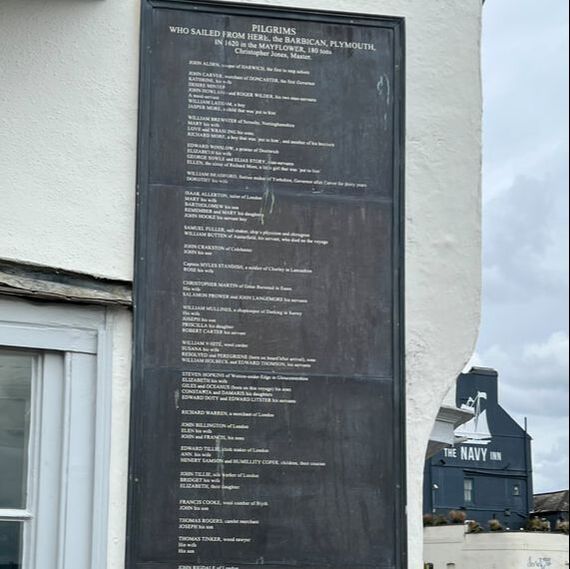
While the actual site where the Pilgrims boarded the Mayflower is likely buried under concrete and road, the granite portico and the steps above were built in 1934 as a commemorative  monument to mark the approximate location of the departure.

In 1620, this area was a natural, rugged coastline. The Pilgrims would have boarded small rowing boats (shallops) from a basic wooden quay or a rocky outcrop to be ferried out to the Mayflower, which was anchored in deeper water in the middle of the harbor.

​Plymouth was the final English port the Pilgrims saw before their 66-day journey across the Atlantic. Although, did they stop in Newlyn before they finally took off? 

The settlers eventually named their new colony Plymouth in honor of the kindness and hospitality they received from the people of this city during their stay.
Picture
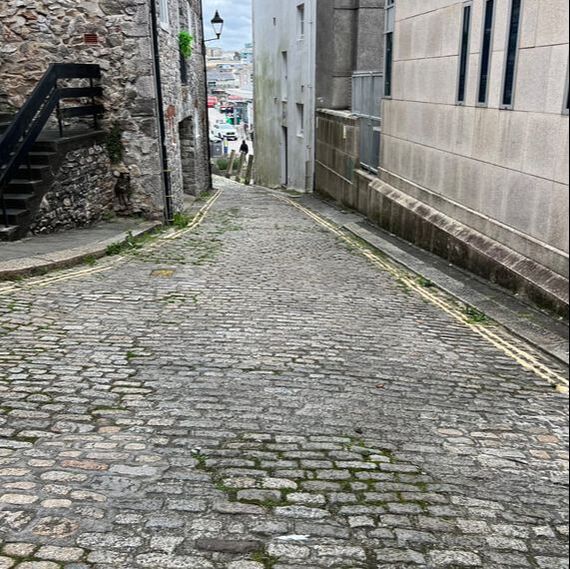
New Street is one of the most famous and well-preserved streets in the city, dating back to the Tudor and Jacobean eras. The area contains a high concentration of listed buildings, and New Street specifically is home to:

Elizabethan House: A 16th-century merchant's house (on the left) that has been restored as a museum to show what life was like in Plymouth during the era of Sir Francis Drake.

The Cobbles: The street is renowned for its original limestone cobbles, which have been worn smooth by centuries of foot traffic.
​
The Layout: The narrowness of the street and the way the buildings lean out over the path (jettying) was a common design to maximize space on the upper floors of 16th-century city houses.

Picture
We checked out the steps where the pilgrims purportedly walked,​ ate at some rather good restaurants, and walked around the Royal Citadel, a historic fortress that’s defended the coastline since the 1600s. You can feel the flow of history while walking the narrow cobbled lanes of the Barbican, a circuit of ancient streets with 200 listed buildings of Tudor and Jacobean architecture. Lots of little shops and bakeries, which of course we sampled. ​
Picture
Picture
Picture
Picture
An important Royal Naval port, Plymouth is home to England’s biggest seaports and naval bases; you can often see frighteningly massive military ships out at sea. 
Picture

The South West Coast Path
Our Journey
The Hikes
Trail Notes
Contact

​

Burly Biker Dude on Yorkshire Pudding

​Copyright © 2026
  • South West COAST Path
  • Our journey
  • Trail Notes
  • The Hikes
    • Somerset & Exmoor Hikes
    • North Devon Hikes
    • North Cornwall Hikes
    • West Cornwall Hikes
    • South Cornwall Hikes
    • South Devon Hikes